This page is about why I wanted to do the Forest Therapy Partitioner training. Focusing on what spending time in nature means to me. What the research tells us. Thankfully, there’s lots of science to back up why being in nature is good for us 🙂
Why did I want to become a Forest Therapy Practitioner?
For the past few Years, I have been intentionally deepening my connection to nature. An avid activist and protector of wild spaces and creatures of all shapes and sizes. My attention turned to reading a lot of books about other people’s experiences in nature. This, along with moving to a house that is very close to a small woodland that I walked in daily. I became more aware of how I responded to being in the woods. On particularly stressful and busy days, I begun to hone in on the sometimes-dramatic shift I would experience once I stepped into the tree cover. For years, when going through anything difficult, nature was where I sought solace. I hadn’t realised the importance of maintaining a practice outside until recently.
In nature, especially woodlands and green spaces, I melt. I soften. The tension I’ve been carrying around disappears.
I intentionally sink in and lose myself amongst the details, the changes, the movement, the feeling of being amongst the trees. I am full of wonder and connection, also empty of thoughts, worry and tension.
Professional reasons for becoming a Forest Therapy Practitioner
Being a walk and talk therapist, I was already partly on my way to wanting to incorporate nature into the sessions. So this felt a very natural transition for me. Walk and talk therapy sessions are taking place in nature in a passive way. Whilst this has many benefits for clients. I wanted to deepen the attention and connection between my clients and the natural spaces we were spending time in. Mindfulness, a form of focused attention, can be an effective and important tool in therapy. In recent years has been widely written about, especially for the treatment of depression.
I think many of us can struggle, at times, to find true belonging with other people. Especially in large groups. If we are sensitive, especially. When I am within the trees, they don’t care for the things I worry about or the memories I still judge myself over. Walking amongst them, I can process things and let them go. I notice that they accept me exactly as I am, regardless of how I show up.
Books that peaked my curiosity further
When I read ‘Finding the Mother Tree’ and ‘The Hidden Life of Trees’ I was amazed at the deep relationship between trees themselves. How they take care of each other and develop connections through mushroom networks underground. The woodlands represent a space of balance – if humans can leave it alone. The different species that interact and live alongside each other create a framework of homeostasis. Maybe that’s what I’m wiring into when I am there.
So naturally, I want to find ways to help people regain or find that connection with the natural world. It’s been an integral part of my wellbeing, my homeostasis. I’m passionate to encourage and facilitate the childlike quality of awe in noticing something in nature. So Forest Therapy Training felt a natural direction to take.
What is Forest Bathing?
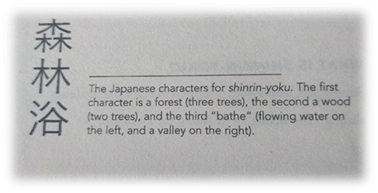
The word Shinrin-Yoku was first coined in Japan in 1982 by Tomohide Akiyama, Director of the Japanese Forestry Agency. It can be directly translated into English as Forest bathing. Simply put, it is the practice of walking slowly in the woods. As well as walking slowly in the woods there are many exercises, known as invitations which help to engage connection and attention in natural environments.
It is spending time in a natural environment, to absorb, through the senses, what is around us, bridging the gap between us and the natural world. It is being curious and open to experiencing through guided mindful activities, hoping to facilitate a connection to nature
Why is Forest Bathing so beneficial?
From the 1990’s many experiments have been conducted to study the physiological effects of shinrin-yoku on the Japanese Island of Yakushima.first measuring saliva cortisol (stress hormone) levels of subjects walking through the forest. Since the 2000’s new techniques have been developed to measure brain activity and autonomic nervous activity. These are good indicators of the level of stress in the human body. Helping to solidify growing evidence into why spending time in woodlands and forests is beneficial to our minds and bodies.
Forest Therapy research has shown:
- Improvement of weakened immunity through increasing the amount of natural killer (NK) cells. These are known to fight tumours and infections.
- Reduction of blood pressure after only 15 minutes of forest therapy in those with high blood pressure
- Increased blood pressure in those with low blood pressure
- Reduction of stress in the body – by decreasing the sympathetic nervous system
- Reduced feelings of stress
- Increased relaxation of the body and an increased sense of well-being
- Significant reduction in symptoms of depression and anxiety
- Lower blood sugar levels
- Improve pain thresholds
- Increases heart rate variability
“We know this deep in our bones. It is like an intuition, or an instinct, a feeling that is sometimes hard to describe. In Japanese, we have a word for those feelings that are too deep for words: yūgen. Yūgen gives us a profound sense of the beauty and mystery of the universe. It is about this World but suggests something beyond it.” Li 2018
Reasons for the physical and psychological benefits of Forest Therapy
Phytoncides
Phytoncides are the natural oils within a plant. They are part of the tree’s defence system, released when the tree is under attack from bacteria, insects or fungi. They are also involved in communication between trees. There are more phytoncides in warmer weather. Experiments have shown that exposure to these natural oils significantly decreased levels of stress hormones. Decreased the scores for tension, anxiety, hostility, fatigue and confusion. Increased sleep hours and the number of NK cells and NK activity. Improved immunity, increased heart rate variability and significantly lowered blood pressure and heart rate.
Microbes within the soil
A common and harmless bacteria that lives in the soil – Mycobacterium Vaccae. Oncologist Dr Mary O’Brien, conducted experiments injecting patients with lung cancer and found it “significantly improved patient quality of life,” patients reported feeling more positive, with higher energy levels and better cognitive functioning.
Cognitive benefits
Research has shown improvements in memory after walking in areas with trees – improvement by 20%, decrease in rumination as walking in nature helps us to change the way we think about things, a 50% boost in problem-solving skills and creativity after being immersed in nature for a few days.
When we spend time in nature we are reminded that we are connected and part of something larger than ourselves. We even become more helpful and caring after watching DVDs of the documentaries Planet Earth and looking at photos of very tall trees.
Attention Restoration Theory
Kaplan & Kaplan (1989) researched the restorative effects of natural environments, which resulted in them introducing the term ‘Attention Restoration Theory.’ This theory focused on William James’s concept of voluntary and involuntary attention. The effect of paying attention to work and daily chores has on our cognitive functioning, in comparison to a ‘soft’ fascination that spontaneously happens when in a natural environment. When we spend enjoyable time in nature, with enjoyable views, birdsong and water, it facilitates a feeling of wellbeing. A greater sense of capacity for everyday life whilst feeling emotionally restored. They outlined the importance of a well-matched environment for participants.
Biophilia Hypothesis
The Biophilia hypothesis (Wilson 1994) is the assertion of humans having an innate tendency to focus on life and life-like processes. Arguing that biologically we are programmed to seek a connection with the natural World. The hypothesis states that our relationship to nature determines our identity and personal fulfilment – an ongoing journey of knowing and following our life’s goals.
In conclusion
Hopefully, after reading the above you will be starting to think about which natural spaces you can start spending more time in. Whether it is the research data showing the physical and psychological benefits of forest bathing. The hypothesis’s mentioned that help join the dots. The start is recognising how it feels to spend intentional time in nature. Highlighting to ourselves the shift that occurs, when we are able to sink down into a more peaceful and restorative place.
It isn’t comfortable or familiar for the majority of us to spend time in nature on our own. This is where forest therapy sessions can help, as an invitation to deepen the connection between you and nature. Offering different ways to be in nature and provide a community to be alongside you. If you would like to contact me regarding a forest therapy session, please read more here.